Deepinder Goyal, the Man Who Gave a Delivery App a Personality
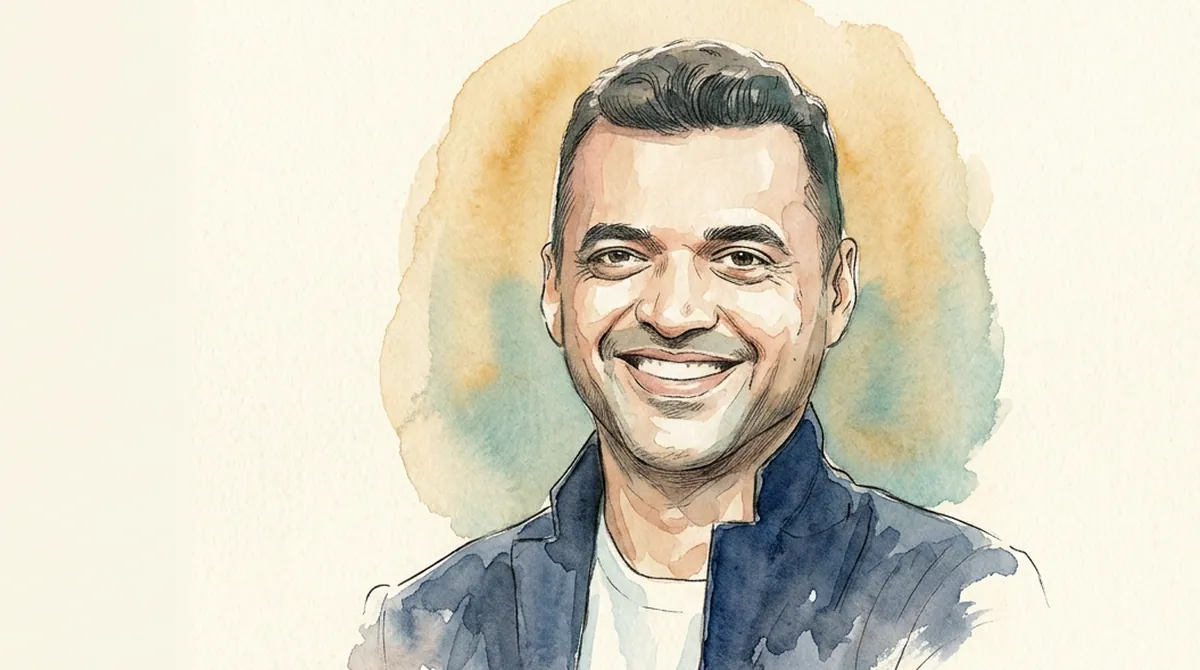
Deepinder Goyal didn't invent food delivery. He invented the idea that a delivery app could talk like a person you'd want to hear from.
Food delivery did not need Zomato to exist. The idea of ordering a meal through an app was already being tried in Indian cities by the time Deepinder Goyal built his company into a household name. What Zomato actually invented was a personality: a brand that talked like a person you knew rather than a company trying to sell you dinner, and that personality mattered more, over time, than any single feature the app shipped.
A consultant who noticed a photocopied menu
Goyal graduated from IIT Delhi in 2005 with a degree in mathematics and computing and joined Bain & Company as a management consultant. The founding story he has told repeatedly traces to something mundane: colleagues crowding around a single, often photocopied restaurant menu at lunchtime, with no easy way to see what else was nearby. With fellow Bain analyst Pankaj Chaddah, he built a site to scan and list restaurant menus. It went live in January 2008 as Foodiebay and formally launched that July. By 2010 the site had expanded well beyond Delhi, and the name, which invited confusion with eBay, was dropped for Zomato. For years after, the company was a discovery and reviews product, not a delivery one, and it built its early audience in that smaller, less glamorous way before delivery came at all.
Giving the app a voice of its own
Zomato became known less for what it delivered than for how it talked while doing it. Its social team wrote push notifications and tweets in a conversational, faintly irreverent register, riffing on memes and news of the day the same afternoon rather than on a campaign calendar. People began screenshotting the notifications and sharing them like a friend's joke, some saying they kept the app installed partly to read them, an unusual thing for a notification to earn. It reflects a decision Goyal's team made early and kept: write like a person, move fast, and trust that being genuinely funny sells as reliably as a discount does.
Restructuring the company to match the brand's ambitions
By the mid-2020s Zomato was no longer only a food app. It had acquired the quick-commerce platform Blinkit in June 2022 for about $568 million in an all-stock deal, and built District, a ticketing and going-out product, alongside Hyperpure, its restaurant supply business. Rather than force all of this under an increasingly overloaded "Zomato" name, the company renamed its listed parent Zomato Limited to Eternal Limited in February 2025, letting each consumer app keep its own name and voice while Eternal became the holding identity above them, a bet that four personalities would serve customers better than one stretched thin. The company had gone public back in July 2021, the first Indian startup unicorn to list domestically, at a valuation north of $8 billion, stock jumping more than 60 percent on debut. Investors were not only pricing delivery logistics; they were pricing a brand that had built real affection in a category where trust is otherwise fragile.
Where the goodwill has cracked
In March 2024, Zomato launched a "pure veg fleet," with riders delivering vegetarian-only orders in green uniforms instead of red. Critics, including Congress MP Karti Chidambaram, called it socially regressive, arguing a color-coded fleet echoed caste-based ideas about vegetarian food needing protection from contamination. Zomato reversed the plan within a day, and Goyal said the company had not thought through the safety risk to riders in neighborhoods with strong vegetarian sentiment. Separately, delivery workers have staged repeated pay strikes, disputing Goyal's claim of roughly Rs 102 an hour in average earnings against union estimates closer to Rs 81 net of costs, as per-order base pay has fallen in many markets from roughly Rs 40-45 to Rs 15-20.
The same instinct that makes a brand quick and clever in public can look glib the moment it gets applied to an actual grievance instead of a meme.
The lesson in the handoff
In January 2026, Goyal announced he would step down as Eternal's Group CEO effective February 1, staying on as vice chairman while Albinder Dhindsa, who built Blinkit, takes over. He said he wanted to chase riskier ventures, including an aviation startup and a longevity research firm, that did not belong inside a listed company. Whatever comes of those, the handoff says something about what he built: a voice and structure durable enough to survive without its founder in the room, the real test of whether a personality was ever the company's or just one person's.